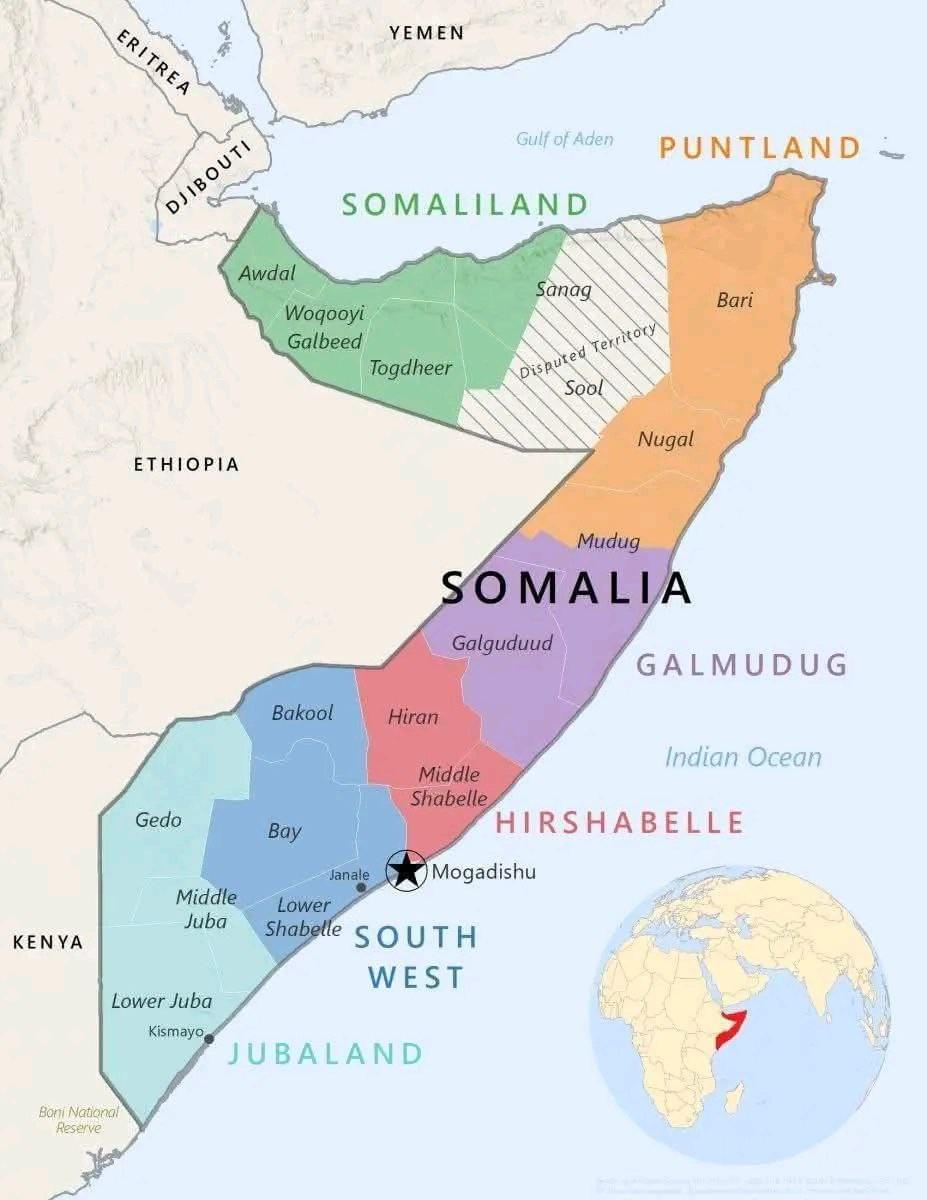
When the issue of recognizing Somaliland is discussed the conversation often focuses on legal arguments, historical borders, and diplomatic recognition. What is discussed far less, however, is the more serious question: what happens the day after recognition? History shows us that recognition does not always bring stability. In many cases, it becomes the starting point of deeper conflict.
If Somaliland were to be recognized while internal political divisions still exist—particularly in regions such as Awdal, where strong support for Somalia’s unity has been openly expressed—the risk would not be theoretical. It would be real. Recognition in the absence of internal consensus can trigger civil conflict, as different communities interpret that decision in fundamentally different ways. Some may see it as liberation, while others view it as imposed separation.
A civil conflict inside Somaliland would not remain contained within its borders. Somalia as a whole, already struggling with fragile security, would be directly affected. The Federal Government of Somalia would likely see recognition as a threat to territorial integrity, while various political and armed actors could view the situation as an opportunity to expand influence. At that point, the issue would move beyond a local dispute and evolve into a broader Somali conflict.
At the regional level, the Horn of Africa is already a highly sensitive and strategic area. Ethiopia closely monitors developments that could affect its security and access to maritime routes. Djibouti, whose economy depends heavily on stability and port activity, cannot afford instability next door. A contested recognition could therefore create a chain reaction, destabilizing the wider region.
The most serious risks emerge when we consider the Red Sea and the Middle East. The Red Sea is one of the world’s most critical trade corridors. Any instability along its shores directly affects global commerce. If Somaliland were to become a conflict zone, ports, shipping lanes, and maritime security would be at risk. This would immediately attract the attention of regional and global powers.
his is where the connection to the Middle East becomes unavoidable. The region is already shaped by the long-standing rivalry between Iran and Israel, a confrontation that often plays out indirectly through strategic waterways and proxy arenas. Iran seeks influence along key maritime routes, while Israel views Red Sea security as vital to its national and economic interests.
In a scenario where Somaliland is recognized amid political turmoil, the area could become another arena of indirect competition between these powers. What begins as a local political issue could slowly resemble the Yemen model—where an internal conflict transformed into a prolonged regional war involving external actors.
The role of the Houthis in Yemen offers a clear warning. A local armed group was able to disrupt global shipping in the Red Sea, proving how fragile international trade can be when regional conflicts intersect with strategic waterways. If a similar environment of instability were to emerge in northern Somalia or Somaliland, the consequences could be even more severe, given the geographic proximity to key maritime routes.
The economic consequences would be immediate and far-reaching. Investors would withdraw, infrastructure development would stall, and regional trade would decline. On a global level, disruptions in the Red Sea would drive up shipping costs, insurance rates, and commodity prices. Once again, instability in one corner of the world would be felt across international markets.
In conclusion, recognizing Somaliland without internal reconciliation, Somali-wide dialogue, and regional security guarantees would be a high-risk political gamble.Rather than delivering peace and progress, it could ignite internal conflict, invite regional intervention, and contribute to wider instability stretching from the Horn of Africa to the Middle East.
The real question, therefore, is not whether recognition is possible—but whether it is responsible under current conditions. Is the goal a rapid political decision that risks long-term chaos, or a slower, negotiated process that prioritizes stability, unity, and lasting peace?
That is the question the international community must seriously confront